A healthy lifestyle is built on consistent daily habits, but it’s also shaped by the experiences we give ourselves when we step outside those routines. Travel, done right, is one of those experiences. Not the rushed, over-scheduled kind that leaves you drained, but the kind where you spend a full day in the open air, using your body, quieting your mind, and returning to the world that exists beyond a screen.
Krabi, on Thailand’s Andaman coast, is that kind of travel. The province is built around water: the Andaman Sea, limestone karst islands rising from the shallows, mangrove estuaries, hidden lagoons, and beaches accessible only by boat. A day spent island-hopping here is also a day of swimming, kayaking, walking, and absorbing the particular quality of silence that comes from being far enough from a road that you can’t hear traffic. For anyone serious about the relationship between lifestyle and health, that kind of day deserves more credit than it usually gets.
Here are eight reasons a Krabi boat tour belongs in the same conversation as the rest of your wellness practice.
1. Time on the Water Measurably Reduces Stress Hormones
The research on what proximity to water does to the human nervous system has been building steadily over the past two decades. Marine biologist Wallace J. Nichols, in his widely cited work on what he calls “blue mind,” documented how time near, in, or on water consistently lowers cortisol levels, reduces heart rate, and shifts the brain into a more meditative, less reactive state. The effect is stronger than equivalent time in built environments and comparable to the best-studied mindfulness interventions.
A Krabi boat tour gives you a full day of this. You’re on the water from morning until late afternoon, moving through landscapes that are as far from urban stress triggers as it’s possible to get. The boat, the islands, the sea: they ask nothing of you except that you pay attention. That’s not nothing. For most people, a full day without digital demand and environmental noise is a genuine physiological event, and the Andaman Sea provides the setting for it better than most places on earth.
2. Sea Kayaking Through the Mangroves Is a Full-Body Workout in Disguise
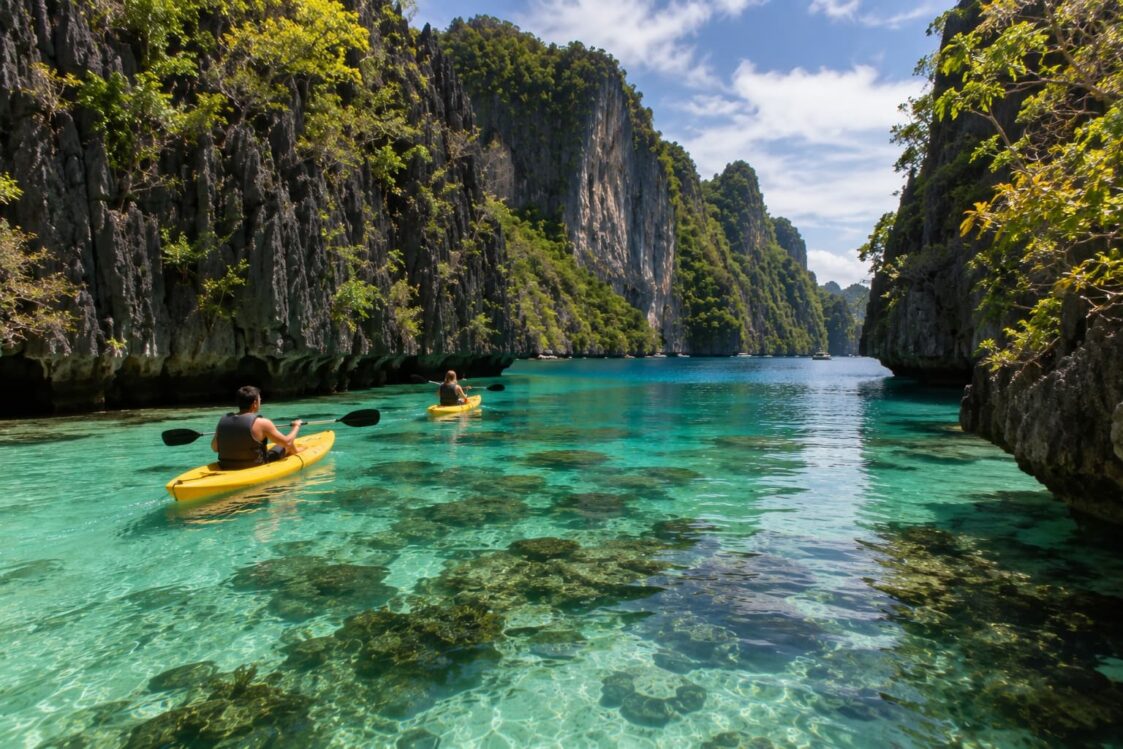
Several of the standard Krabi island-hopping routes include time in sea kayaks, paddling through mangrove channels and into partially enclosed lagoons. It doesn’t feel like exercise in the gym sense, which is part of the point. You’re focused on navigating the channel, watching the root systems of the mangroves, listening to the birds, and occasionally ducking under a low overhang. The fact that you’re working your shoulders, back, core, and arms continuously for 45 minutes to an hour is secondary to the experience, but the physical work is real.
This is what exercise researchers call incidental or intrinsically motivated physical activity: movement that happens because you’re doing something you want to do rather than something you feel obligated to do. The adherence rates for this kind of movement are dramatically higher than for programmed gym exercise, and the enjoyment factor amplifies the mood benefits considerably. A morning paddle through Krabi’s mangroves does more for most people’s physical health than the same duration on a treadmill, even if the calorie numbers look similar on paper.
3. Swimming in Clean Open Water Has Benefits That Pool Swimming Cannot Match
The Andaman Sea around Krabi is warm year-round, averaging around 28 to 30 degrees Celsius depending on season, and the water clarity at the better snorkelling sites is good enough to see the reef below in 10 or more metres of depth. Swimming in open water of this quality is a different physical experience from pool swimming: the resistance is slightly different, the buoyancy from salt water changes how your body sits in the medium, and the visual environment keeps you present in a way that staring at lane lines doesn’t.
Cold water swimming has received considerable attention for its immune and mood effects, but warm, clean open water swimming has its own profile of benefits, including improved cardiovascular function, reduced inflammation markers, and the mood uplift that comes from endorphin release during sustained physical effort in a pleasurable environment. Most people on a Krabi boat tour swim two or three times across the day without thinking of it as exercise at all. That’s ideal.
4. The Limestone Karst Environment Encourages Natural Mindfulness
Krabi’s defining landscape is its karst limestone formations: sheer-sided towers rising from the sea and the inland plains, riddled with caves and overhangs, covered in vegetation that clings to near-vertical rock faces. Moving through this environment by boat has a specific effect on attention. The formations are strange enough, and varied enough, that the mind keeps being pulled to look at them rather than retreating into rumination or planning.
This is a natural form of what mindfulness researchers call “soft fascination,” the effortless, non-demanding attention that restorative environments produce. Unlike the directed concentration required by work or problem-solving, soft fascination allows the prefrontal cortex to rest while the mind remains gently engaged. The Krabi karst landscape sustains this state across an entire day, which is longer than most formal mindfulness sessions and requires no instruction or prior practice. The environment does the work. As our piece on Vipassana and a healthy lifestyle explores, the ability to quiet the mind’s noise and simply observe is one of the most powerful tools for nervous system restoration, and Krabi provides one of the most accessible settings for it.
5. Eating Fresh Seafood on the Beach Supports the Nutritional Side of Wellbeing
Most Krabi boat tours include a stop for lunch at one of the island beaches or at a floating pontoon where fresh grilled fish, squid, prawns, and vegetables are served. The food is simple, local, and prepared the same day it came out of the water. You eat it with your feet in the sand, probably slightly salt-dried from the last swim, while a breeze comes off the Andaman and the boat rocks gently at anchor nearby.
This is not incidental to the health value of the day. How we eat matters as much as what we eat, and eating slowly, in a pleasant outdoor environment, without phones or work or the ambient noise of a restaurant, supports the parasympathetic nervous state that proper digestion requires. The Mediterranean dietary research that has done so much to establish the health value of fish, olive oil, and vegetables didn’t isolate those foods from the lifestyle context in which they were consumed. Eating fresh Thai seafood on a beach in Krabi is a similar kind of experience: food and setting working together in the right direction.
6. Guided Boat Tours Provide the Local Knowledge That Makes the Day Richer
Krabi has dozens of islands and several distinct island-hopping routes, each covering a different cluster of sites. The difference between a well-chosen itinerary and a generic one is the difference between seeing the best of what the area offers and spending the day at the most crowded spots with the worst snorkelling visibility. Local knowledge about tides, currents, seasonal conditions, and which sites are accessible at which times of day determines the quality of the experience significantly.
Operators like Krabi Boat Tours run structured itineraries that reflect this local expertise, covering the key sites of Railay Beach, the Four Islands, Phi Phi, and the Hong Island group with guides who understand the conditions and can adapt on the day. For travelers who want the full physical and mental health benefits of a day on the Andaman Sea rather than a logistically stressful one, having that structure in place removes friction and lets the day do what it’s supposed to do.
7. Time in Tropical Nature Has Documented Immune System Benefits
The research tradition initiated by Japanese scientists studying shinrin-yoku, or forest bathing, has expanded considerably beyond forests. Exposure to biodiverse natural environments, including coastal and island ecosystems, has been linked to increased natural killer cell activity, reduced inflammatory markers, and improved immune function lasting for weeks after the exposure. The mechanism appears to involve phytoncides: volatile compounds released by plants and trees that the human immune system responds to in measurable ways.
A day in Krabi’s island environment puts you in contact with tropical forest vegetation, mangrove ecosystems, and open sea air for hours at a stretch. This is a different biological exposure from a day in an air-conditioned hotel or shopping environment, and the immune data suggests the difference is not trivial. For people who approach health holistically, as we discuss in our overview of healthy lifestyle principles, the environment you spend time in is as much a part of your health practice as what you eat or how you sleep.
8. The Social Experience of a Boat Tour Supports Emotional Wellbeing
A day on a boat with a small group of people, whether friends, family, or strangers who become temporary companions, produces a particular kind of social bonding that everyday life rarely generates. Shared physical experience, shared meals, shared wonder at a landscape: these are the conditions under which people connect quickly and well. The social psychology research on this is consistent: experiences that involve mild novelty, shared physical activity, and time outside the usual social context produce stronger bonding than equivalent time in familiar settings.
For people who live with chronic stress, isolation, or the low-grade social thinness that modern urban life tends to produce, a day like this is a corrective. Not a permanent one, and not a substitute for the deeper social investment that long-term wellbeing requires. But a real one, with measurable effects on mood, oxytocin levels, and the sense of connection to other people that underlies psychological health. The Andaman Sea is a good place to be reminded of what it feels like when that connection comes easily.
A Final Thought
A healthy lifestyle is not only what you do every day at home. It’s also the choices you make when you have the opportunity to step outside your normal environment and give your body and mind something different to work with. Krabi offers a day that delivers on almost every dimension of physical and mental wellbeing: movement, clean air, clean water, good food, natural beauty, reduced stress, immune stimulation, and social connection.
None of that requires any special preparation or prior fitness level. You show up at the boat in the morning. The rest of it takes care of itself.
That’s a good day by almost any measure.